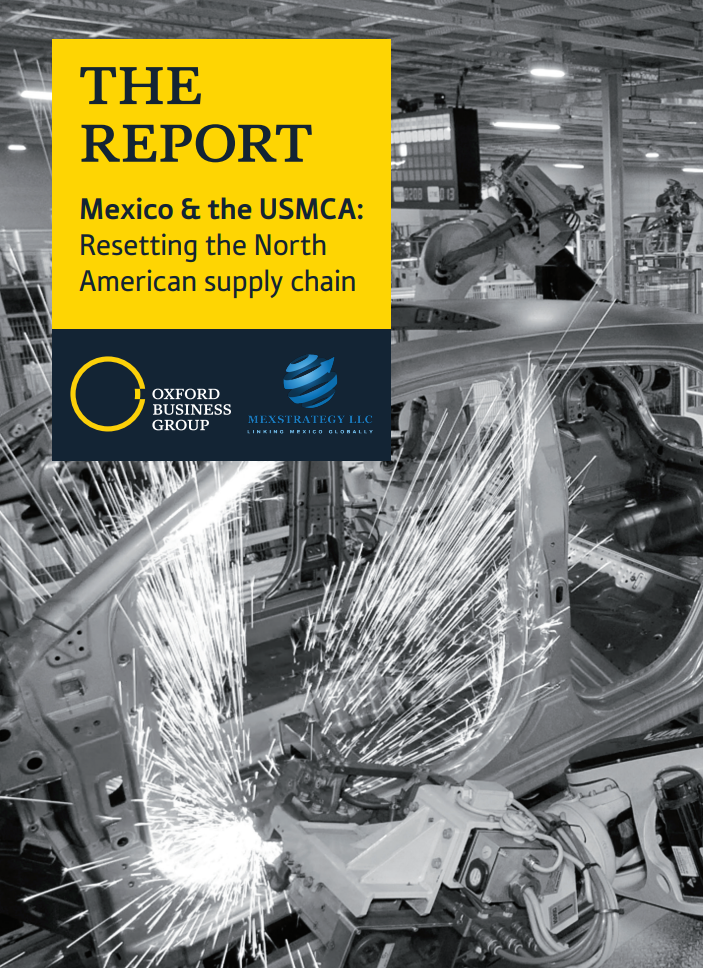
MEXICO, MEXICO, April 24, 2026 /EINPresswire.com/ — Oxford Business Group (OBG), in partnership with MexStrategy, officially launched its latest high-level report, Mexico & the USMCA: Resetting the North American Supply Chain, at the Mexican Pavilion during the opening day of Hannover Messe 2026.
The launch followed a ribbon-cutting ceremony attended by the Mexican Ambassador to Germany and key industrial leaders. Following the ceremony, Oliver Cornock, Global Editor-in-Chief at OBG, presented the report’s findings and engaged in a fireside interview with Daniel Hernández Galindo, Senior Partner at MexStrategy, to discuss Mexico’s evolving role as a global manufacturing titan.
Redefining the Mexico Opportunity
The report argues that Mexico’s competitive edge has shifted from simple cost arbitrage to a sophisticated governance story. Success for global firms now depends on operational discipline, regulatory compliance, and supply chain design rather than just proximity.
Key Report Highlights:
• Industrial Powerhouse: Mexico reached a production record of 3.99 million light vehicles in 2024, with roughly 18% of all vehicles sold in the US now assembled in Mexico. The aerospace sector is projected to nearly double in value to $22.7 billion by 2029.
• Trade Access: With 14 free trade agreements covering 52 countries, including the USMCA and a newly modernized EU-Mexico agreement, Mexico offers unparalleled market access.
• Regional Specialisation: The report maps six distinct corridors, ranging from Baja California’s medical device cluster to Querétaro’s aerospace hub.
• Fiscal Incentives: Under Plan Mexico and the 2025 Fiscal Stimulus Decree, the government has allocated up to $30 billion in incentives, including asset deductions of up to 91% for strategic sectors.
• ESG Leadership: Mexico is the first emerging economy to mandate ESG disclosures for non-listed companies, signalling a major shift toward sustainable industrial transition.
Expert Insight: A Conversation with Oliver Cornock
During the interview with Daniel Hernández Galindo, Oliver Cornock shared insights on why Mexico is the linchpin of North American supply chain reconfiguration.
On Mexico’s central role in supply chains:
“Mexico is no longer just a ‘nearshoring’ destination; it is the core of a North American production platform. With 80% of exports tied to the US, Mexico’s integration is a structural necessity for regional resilience. It provides the scale and depth—particularly in the automotive and aerospace tiers—that simply cannot be replicated elsewhere in the hemisphere.”
On the “Operating System” concept:
“We advise investors to view Mexico as an ‘operating system’ of interoperable corridors. It’s not about just picking a spot on a map; it’s about configuring the right stack of energy, workforce, and logistics. Those who treat it as a system convert volatility into a competitive advantage.”
On the comparison with India and Vietnam:
“Speed and integration set Mexico apart. While Asian hubs face congested maritime corridors, Mexico offers shipping timelines to the US as short as 48 hours. Combined with 14 FTAs and shared time zones, the ‘land-bridge’ advantage offers a level of reliability that maritime-dependent hubs currently struggle to match.”
On the energy constraint:
“Energy is the single most critical variable for scaling. Currently, only 22% of Mexico’s electricity is renewable. To reach the 2030 target of 45% clean energy, Mexico must install 46 GW of new solar and wind capacity. The winners will be those who build around these bottlenecks and prioritize usable megawatts.”
The final message to global investors:
“Don’t just ‘enter’ Mexico—configure it. Success today is determined by how well you design for variability and governance. Mexico doesn’t eliminate risk, but it gives you the architecture to manage it.”
https://oxfordbusinessgroup.com/reports/report-mexico-evolving-position-in-global-supply-chains-analysis-research-focus-report/
SPANISH Version
OBG y MexStrategy lanzan informe definitivo sobre nearshoring en Hannover Messe 2026
Oxford Business Group (OBG), en alianza con MexStrategy, lanzó oficialmente su más reciente informe de alto nivel, México y el T-MEC: Reconfigurando la cadena de suministro de América del Norte, en el Pabellón de México durante la jornada inaugural de Hannover Messe 2026.
El lanzamiento se llevó a cabo tras una ceremonia de corte de listón encabezada por el Embajador de México en Alemania y destacados líderes industriales. Después del acto, Oliver Cornock, Editor Global en Jefe de OBG, presentó los hallazgos del informe y participó en una entrevista con Daniel Hernández Galindo, Socio Senior de MexStrategy, para analizar el papel cambiante de México como potencia manufacturera global.
Redefiniendo la oportunidad México
El informe sostiene que la ventaja competitiva de México ha evolucionado de un simple arbitraje de costos hacia una narrativa sofisticada de gobernanza. El éxito para las empresas globales ahora depende más de la disciplina operativa, el cumplimiento regulatorio y el diseño de cadenas de suministro que únicamente de la proximidad geográfica.
Principales hallazgos del informe:
• Potencia industrial: México alcanzó un récord de producción de 3.99 millones de vehículos ligeros en 2024, mientras que cerca del 18% de todos los vehículos vendidos en Estados Unidos ahora se ensamblan en México. Se proyecta que el sector aeroespacial casi duplique su valor hasta alcanzar los 22.7 mil millones de dólares para 2029.
• Acceso comercial: Con 14 tratados de libre comercio que abarcan 52 países, incluyendo el T-MEC y un acuerdo modernizado entre México y la Unión Europea, el país ofrece un acceso a mercados sin precedentes.
• Especialización regional: El informe identifica seis corredores distintos, que van desde el clúster de dispositivos médicos en Baja California hasta el hub aeroespacial de Querétaro.
• Incentivos fiscales: Bajo el Plan México y el Decreto de Estímulos Fiscales 2025, el gobierno ha destinado hasta 30 mil millones de dólares en incentivos, incluyendo deducciones de activos de hasta 91% para sectores estratégicos.
• Liderazgo ESG: México es la primera economía emergente en exigir divulgaciones ESG para empresas no listadas en bolsa, lo que marca un cambio importante hacia una transición industrial sostenible.
Visión experta: conversación con Oliver Cornock
Durante la entrevista con Daniel Hernández Galindo, Oliver Cornock compartió su visión sobre por qué México es la pieza clave en la reconfiguración de las cadenas de suministro de América del Norte.
Sobre el papel central de México en las cadenas de suministro:
“México ya no es solo un destino de nearshoring; es el núcleo de una plataforma productiva norteamericana. Con el 80% de sus exportaciones vinculadas a Estados Unidos, la integración de México es una necesidad estructural para la resiliencia regional. Ofrece escala y profundidad —particularmente en los niveles automotriz y aeroespacial— que simplemente no pueden replicarse en otra parte del hemisferio.”
Sobre el concepto de ‘sistema operativo’:
“Aconsejamos a los inversionistas ver a México como un sistema operativo de corredores interoperables. No se trata solo de elegir un punto en el mapa; se trata de configurar la combinación correcta de energía, talento y logística. Quienes lo entienden como un sistema convierten la volatilidad en ventaja competitiva.”
Sobre la comparación con India y Vietnam:
“La velocidad y la integración distinguen a México. Mientras los hubs asiáticos enfrentan corredores marítimos congestionados, México ofrece tiempos de envío a Estados Unidos de apenas 48 horas. Combinado con 14 TLC y zonas horarias compartidas, la ventaja de puente terrestre ofrece un nivel de confiabilidad que los centros dependientes del transporte marítimo hoy tienen dificultades para igualar.”
Sobre la restricción energética:
“La energía es la variable más crítica para escalar operaciones. Actualmente, solo el 22% de la electricidad de México proviene de fuentes renovables. Para alcanzar la meta de 45% de energía limpia en 2030, México debe instalar 46 GW adicionales de capacidad solar y eólica. Los ganadores serán quienes construyan alrededor de estos cuellos de botella y prioricen megawatts utilizables.”
Mensaje final para inversionistas globales:
“No solo entren a México: configúrenlo. Hoy el éxito depende de qué tan bien diseñen para la variabilidad y la gobernanza. México no elimina el riesgo, pero sí ofrece la arquitectura para gestionarlo.”
Marc-André de Blois
About Oxford Business Group
+971 4 426 4642
email us here
Visit us on social media:
LinkedIn
Facebook
YouTube
X
Legal Disclaimer:
EIN Presswire provides this news content “as is” without warranty of any kind. We do not accept any responsibility or liability
for the accuracy, content, images, videos, licenses, completeness, legality, or reliability of the information contained in this
article. If you have any complaints or copyright issues related to this article, kindly contact the author above.

Media gallery