FAYETTEVILLE, GA, UNITED STATES, April 28, 2026 /EINPresswire.com/ — Nighttime light data are widely used to track urbanization, economic activity, and human development, but existing satellite records are fragmented and inconsistent across time. This study developed a deep-learning framework to reconstruct a global, high-resolution nighttime light dataset from 1992 to 2024. The new product improves continuity, reduces saturation-related bias, and better captures long-term spatial and socioeconomic change than previous calibrated datasets.
Nighttime light (NTL) observations have become an important proxy for measuring human activity, urban growth, and socioeconomic dynamics. However, the two major sources of NTL data differ substantially. The Defense Meteorological Satellite Program Operational Line Scanning System (DMSP-OLS) provides a longer historical record but has coarser spatial resolution, lower radiometric sensitivity, and serious saturation problems, while the Suomi National Polar-orbiting Partnership’s Visible Infrared Imaging Radiometer Suite (NPP-VIIRS) offers finer and more sensitive observations but only began annual coverage in 2012. Earlier efforts to harmonize these datasets often sacrificed detail or introduced bias, especially in brightly lit urban cores. Based on these challenges, in-depth research is needed on long-term, high-resolution, and cross-sensor consistent nighttime light reconstruction.
A team from Fuzhou University, East China Normal University, Anhui Normal University, and Yunnan Normal University reported (doi: 10.34133/remotesensing.0874) on 31 march 2026 in Journal of Remote Sensing reconstructs a new global nighttime light dataset that extends NPP-VIIRS-like annual observations back to 1992. The study addresses a major limitation in earth observation: the lack of a single, temporally continuous, radiometrically consistent night-light record suitable for long-term monitoring of urbanization, economic shocks, and human settlement dynamics across the globe.
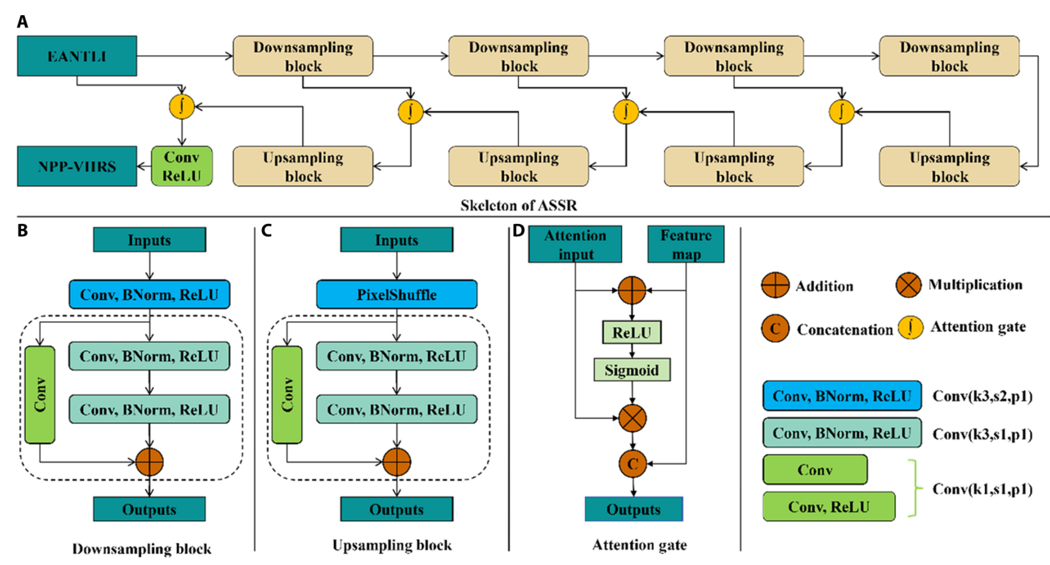
The study combined annual Landsat enhanced vegetation index (EVI), harmonized DMSP-OLS data, monthly NPP-VIIRS data, and auxiliary masking and validation datasets to reconstruct a longer and sharper light record. First, the team built an EVI-adjusted nighttime light index (EANTLI) to reduce saturation effects in DMSP-OLS imagery. They then developed and trained an Attention U-Net with Skip connection for super resolution (ASSR) using 2013 NPP-VIIRS annual NTL data as labels and 2012 data for validation. Finally, the Version 2 NPP-VIIRS-like NTL data were reconstructed based on the ASSR model. This dataset spans 1992–2024, extending the earlier Version 1 record that began in 2000, and retains the NPP-VIIRS unit of nanowatts per square centimeter per steradian (nW·cm⁻²·sr⁻¹) and a spatial resolution of 15 arc sec.
The Version 2 NPP-VIIRS-like NTL data achieved strong agreement with official NPP-VIIRS annual data, with R² values of 0.66 at the pixel level, 0.91 at the city level, and 0.93 at the provincial level. In difficult DMSP-OLS saturation regions, it also outperformed the SVNTL benchmark, reaching R² = 0.54 and root mean square error (RMSE) = 20.18, compared with R² = 0.22 and RMSE = 31.47 for SVNTL. Beyond accuracy, the dataset preserved clearer spatial detail and showed smoother temporal continuity across the critical 2011–2013 transition. Temporal checks further showed that the dataset could reflect major economic changes, including the 2004 European slowdown, the 2008 global recession, and recent disruptions in Ukraine. Global fits with gross domestic product (GDP) and population reached R² values of 0.91 and 0.92, respectively.
This dataset opens new possibilities for tracking multi-decadal urban expansion, economic resilience, infrastructure growth, and demographic change at global scale. It could support applications in development monitoring, disaster assessment, regional planning, and cross-country socioeconomic comparison. The authors also note that the current product is annual rather than monthly or daily, so future work could focus on finer temporal resolution to better capture rapid change. Even so, the new record provides a strong foundation for next-generation long-term nighttime light analysis.
References
DOI
10.34133/remotesensing.0874
Original Source URL
https://spj.science.org/doi/10.34133/remotesensing.0874
Funding Information
This research was funded by the National Natural Science Foundation of China (grant nos. 42371332 and 41801343) and the Natural Science Foundation of Fujian Province (grant no. 2024J09018).
Lucy Wang
BioDesign Research
email us here
Legal Disclaimer:
EIN Presswire provides this news content “as is” without warranty of any kind. We do not accept any responsibility or liability
for the accuracy, content, images, videos, licenses, completeness, legality, or reliability of the information contained in this
article. If you have any complaints or copyright issues related to this article, kindly contact the author above.

Media gallery