The Business Research Company’s Direct Satellite-To-Phone Cellular Global Market Report 2026 – Market Size, Trends, And Forecast 2026-2035
LONDON, GREATER LONDON , UNITED KINGDOM, October 26, 2026 /EINPresswire.com/ — The direct satellite-to-phone cellular market is emerging as a vital segment within the broader telecommunications landscape, promising to revolutionize connectivity by enabling direct communication between satellites and mobile devices. This technology is poised to transform access to communication services, especially in remote and underserved areas where traditional networks fall short. The following overview explores the market’s size, regional dominance, growth drivers, key players, and future opportunities shaping its trajectory.
Direct Satellite-To-Phone Cellular Market Value and Comparison to Parent Markets
The direct satellite-to-phone cellular market is anticipated to exceed $18 billion by 2030. When compared to the larger 5G Services market, which is projected to reach about $2,948 billion by the same year, this segment will make up roughly 1% of its parent industry. Looking at the entire Information Technology sector, expected to be valued at $13,788 billion in 2030, the direct satellite-to-phone cellular market will represent close to 0.1% of this vast technological arena.
Request A Free Sample Of The Direct Satellite-To-Phone Cellular Market Report
https://thebusinessresearchcompany.com/sample_request?id=55465293&type=smp&name=Direct%20Satellite-To-Phone%20Cellular%20Market%20Report%202026&utm_source=EINPresswire&utm_medium=Paid&utm_campaign=Oct_PR
North America’s Role as the Leading Region in 2030
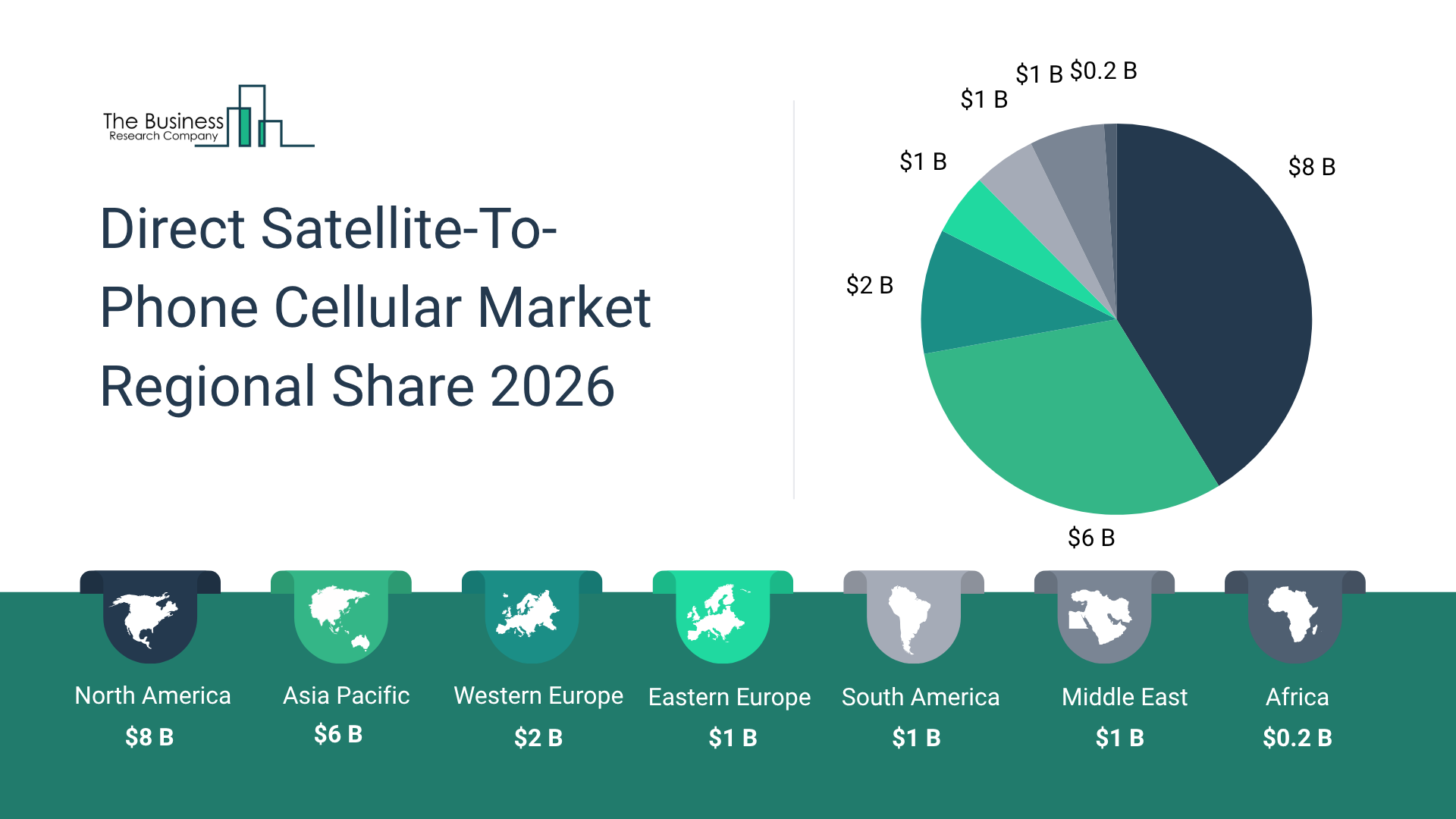
By 2030, North America is set to dominate the direct satellite-to-phone cellular market, with an estimated valuation of $8.0 billion. This marks a remarkable rise from $1.9 billion in 2025, reflecting a compound annual growth rate (CAGR) of 33%. The rapid expansion is fueled by several factors, including the swift deployment of low Earth orbit (LEO) satellite constellations, increasing demand for reliable connectivity in rural and remote locations, and a growing adoption of satellite-based emergency communication services. Additionally, robust investments from telecom operators, integration of satellite capabilities into smartphones and Internet of Things (IoT) devices, as well as expanding defense and public safety communication needs across the USA and Canada, are driving this growth.
The United States as the Largest Country Market by 2030
The United States will emerge as the largest national market within the direct satellite-to-phone cellular sector by 2030, expected to be worth $7.1 billion. Growing from $1.7 billion in 2025 at a CAGR of 32%, this surge is propelled by the commercialization of direct-to-device satellite services. There is a rising demand for uninterrupted connectivity in isolated and disaster-prone areas, alongside telecom operators expanding hybrid satellite-terrestrial networks. Partnerships between smartphone manufacturers and satellite providers, increased use of satellite communication in enterprise logistics, and strong governmental backing for resilient space-based infrastructure further support this growth.
Access The Detailed Direct Satellite-To-Phone Cellular Market Report Here
https://thebusinessresearchcompany.com/report/direct-satellite-to-phone-cellular-global-market-report?utm_source=EINPresswire&utm_medium=Paid&utm_campaign=Oct_PR
Leading Segment by End-User in the Market by 2030
Among various end-user industries, the individual consumer segment will hold the largest share in the direct satellite-to-phone cellular market, accounting for 38% or $7 billion in 2030. This segment benefits from the growing consumer desire for consistent global connectivity, widespread use of satellite-enabled smartphones for travel and outdoor activities, and dependence on emergency SOS services. The expansion of budget-friendly satellite subscription plans, rising adoption of smartphones with built-in satellite features, and popularity in remote or underserved regions with limited terrestrial coverage all contribute to this trend.
Market Segmentation by Type and Connectivity
The direct satellite-to-phone cellular market is categorized by service type into consumer services and mobile satellite services. In terms of connectivity, it is divided into two-way communication and one-way communication, each catering to different user needs and applications.
Projected Compound Annual Growth Rate (CAGR) Until 2030
Looking ahead to 2030, the direct satellite-to-phone cellular market is expected to grow at an impressive CAGR of 38%, reflecting the accelerating adoption of satellite-enabled mobile communication worldwide.
Factors Fueling Growth in the Direct Satellite-To-Phone Cellular Market
One of the primary drivers of this market’s expansion is the increasing demand for connectivity in remote and underserved areas. Satellite-to-phone cellular services offer reliable communication in regions where traditional terrestrial networks are either unreliable or nonexistent. Remote, maritime, rural, and disaster-prone locations benefit greatly from this technology, which supports continuous voice, messaging, and data transmission independent of ground infrastructure. Global initiatives to close the digital divide and enhance universal connectivity further propel this demand, contributing to an estimated annual market growth of 2.4%.
Another important factor is the growing integration of satellite networks with existing mobile ecosystems. Collaboration between telecom providers and satellite communication companies is enabling smartphones to seamlessly switch between terrestrial and satellite networks, enhancing coverage continuity and user experience. Technological advancements in low Earth orbit satellites and compatible chipsets are making direct satellite-to-phone communication more scalable. Hybrid connectivity models are gaining traction among mobile network operators, driving an anticipated annual growth contribution of around 2.1%.
The demand for robust emergency communication and disaster recovery systems is also a significant catalyst. Satellite cellular technology plays a critical role during crises when terrestrial networks fail, ensuring uninterrupted communication for rescue and coordination efforts. Governments and emergency response agencies are investing heavily in resilient communication infrastructures that operate independently of ground networks. This emphasis on disaster resilience and public safety is expected to drive approximately 2.0% annual growth in the market.
Key Opportunities Across End-User Segments in 2030
The direct satellite-to-phone cellular market’s largest growth prospects lie within several end-user industries: individual consumers, media and entertainment, government, defense, aerospace, retail and enterprise, and other sectors. Together, these segments could contribute over $15 billion in market value by 2030. Growth is fueled by the rapid scaling of direct-to-device satellite ecosystems, increasing commercialization of subscription-based satellite services, and rising demand for uninterrupted connectivity in mobility-focused industries. Expanding satellite-enabled emergency and mission-critical communication systems, deployment of integrated satellite-terrestrial networks, and adoption of satellite connectivity for logistics, field operations, and remote workforce communication all support this surge. This trend reflects a broader shift toward seamless global connectivity, enhanced communication resilience, and deeper integration of satellite services into both consumer and enterprise frameworks.
Projected Growth in Market Segments from 2025 to 2030
Between 2025 and 2030, the individual consumer segment is expected to grow by $6 billion, media and entertainment by $1 billion, government and defense markets each by approximately $2 billion, the aerospace sector by $1 billion, retail and enterprise by $2 billion, and other end-user industries by $1 billion.
Competitive Landscape and Innovation in the Market
The market is shaped by a diverse group of global satellite operators and mobile network providers focusing on next-generation direct-to-device connectivity, deployment of low Earth orbit satellite constellations, spectrum-efficient technologies, and seamless terrestrial-satellite integration. Innovations prioritizing low-latency communication, disaster recovery connectivity, coverage in rural and remote regions, and compliance with international regulations are critical to maintaining competitive advantage. For stakeholders seeking growth, technological breakthroughs and strategic alliances will be crucial within the rapidly evolving non-terrestrial mobile connectivity sector.
Market Leader in 2025 and Their Role
Research indicates that SpaceX (Starlink) led global direct satellite-to-phone cellular sales in 2025, capturing 51% of the market share. Their satellite communications division offers extensive low Earth orbit solutions, direct-to-device services, global mobile broadband, and emergency connectivity. These services enable smooth integration with terrestrial mobile networks and provide vital communication support in underserved rural and offshore locations, as well as for disaster recovery efforts.
Other Prominent Players in the Direct Satellite-To-Phone Cellular Market
Key companies active in this market include SpaceX (Starlink), Apple Inc., Globalstar Inc., Iridium Communications Inc., AST SpaceMobile Inc., Qualcomm Incorporated, Viasat Inc., SES S.A., Lynk Global Inc., Omnispace, Verizon Communications Inc., AT&T Inc., Huawei Technologies Co., Ltd., T-Mobile US Inc., Rogers Communications Inc., China Telecom Corporation Limited, Vodafone Group Plc., Telstra Corporation Limited, and OQ Technology.
Market Concentration and Barriers to Entry
The direct satellite-to-phone cellular market is highly concentrated, with the top ten players controlling 74% of total revenue in 2025. This concentration reflects significant technological and regulatory barriers including the complexity of satellite infrastructure, spectrum allocation limits, and the need for regulatory compliance across various regions. Leading companies maintain their positions through large-scale deployment of satellite constellations, proprietary direct-to-device technologies, strategic partnerships with telecom operators, and integrated terrestrial-satellite network ecosystems. As demand grows for seamless global mobile connectivity, emergency communication, and broadband access in remote areas, these firms are expected to strengthen their foothold through innovation, spectrum acquisitions, and network expansion.
Leading Market Shares Held by Top Companies
The market share distribution among the top players in 2025 includes SpaceX (Starlink) with 51%, Apple Inc. at 7%, Globalstar Inc. at 5%, Iridium Communications Inc. with 4%, AST SpaceMobile Inc. and Qualcomm Incorporated each at 2%, followed by Viasat Inc. at 2%, SES S.A. at 1%, Lynk Global Inc. at 0.4%, and Omnispace at 0.3%.
Key Raw Material Providers Supporting the Market
Major suppliers of essential components in the direct satellite-to-phone cellular space include Qualcomm Incorporated, MediaTek Inc., Samsung Electronics Co. Ltd., Huawei Technologies Co. Ltd., Intel Corporation, NVIDIA Corporation, Skyworks Solutions Inc., Qorvo Inc., Broadcom Inc., Infineon Technologies AG, STMicroelectronics N.V., NXP Semiconductors N.V., Analog Devices Inc., Texas Instruments Incorporated, Murata Manufacturing Co. Ltd., TDK Corporation, Amphenol Corporation, L3Harris Technologies Inc., Thales Group, Lockheed Martin Corporation, Northrop Grumman Corporation, Boeing Company, Airbus SE, and Iridium Communications Inc.
Major Distributors and Wholesalers in the Industry
Significant wholesalers and distributors active in this market include SES S.A., Eutelsat Communications S.A., Inmarsat Global Limited, Viasat Inc., EchoStar Corporation, Intelsat S.A., Telesat Corporation, Kymeta Corporation, Kratos Defense and Security Solutions Inc., Speedcast International Limited, Satcom Global Limited, ND SatCom GmbH, Marlink Group, KVH Industries Inc., Gogo Business Aviation LLC, Honeywell Aerospace Services, Cobham SATCOM, Comtech Telecommunications Corp., Gilat Satellite Networks Ltd., Hughes Network Systems LLC, Thuraya Telecommunications Company, Globalstar Inc., AST SpaceMobile Inc., Lynk Global Inc., and Omnispace LLC.
Primary Users of Direct Satellite-To-Phone Cellular Services
Leading end users include major telecom operators and service providers such as AT&T Inc., Verizon Communications Inc., T-Mobile US Inc., Vodafone Group Plc, Deutsche Telekom AG, Orange S.A., Telefónica S.A., Bharti Airtel Limited, Reliance Jio Infocomm Limited, Telstra Corporation Limited, China Mobile Limited, China Telecom Corporation Limited, China Unicom Hong Kong Limited, Rogers Communications Inc., Bell Canada Enterprises Inc., BT Group Plc, Swisscom AG, KDDI Corporation, SoftBank Group Corp., SK Telecom Co. Ltd., NTT Docomo Inc., Telus Corporation, América Móvil S.A.B. de C.V., MTN Group Limited, and Airtel Africa Plc.
Emerging Competitive Trends in the Market
Low Earth orbit (LEO) direct-to-device satellite platforms are reshaping the market by allowing smartphones to connect directly to satellites for voice, messaging, and data without relying on ground networks. A notable example is Rogers Communications, which in July 2025 launched Rogers Satellite, a direct-to-device service utilizing Starlink’s LEO satellites to extend connectivity across 5.4 million square kilometers in remote and underserved Canadian regions. This platform enhances network accessibility, emergency communication capabilities, and coverage in areas traditionally lacking cellular service.
Strategic Moves Companies Are Using to Maintain Market Leadership
To stay competitive, companies are focusing on advancing LEO direct-to-device platforms that improve global coverage and accessibility. They are also leveraging cutting-edge chipsets and modems that support efficient satellite communication. Expanding satellite constellations to boost network reliability, especially in rural areas, and integrating artificial intelligence for better spectrum management and network optimization are key strategies shaping the future of the direct satellite-to-phone cellular market.
New strategic additions in our 2026 market reports include market attractiveness scoring and analysis, total addressable market (TAM) analysis, company scoring matrix graphics and tables, Excel-based forecasting dashboards, market hotspots infographics, key technologies and future trend analysis, along with updated graphics and tables.
Learn More About The Business Research Company
The Business Research Company (www.thebusinessresearchcompany.com) is a leading market intelligence firm renowned for its expertise in company, market, and consumer research. We have published over 30,000+ reports across 27 industries and 60+ geographies. Our research is powered by 1,500,000 datasets, extensive secondary research, and exclusive insights from interviews with industry leaders.
We provide continuous and custom research services, offering a range of specialized packages tailored to your needs, including Market Entry Research Package, Competitor Tracking Package, Supplier & Distributor Package and much more.
Disclaimer: Please note that the findings, conclusions and recommendations that TBRC Business Research Pvt Ltd delivers are based on information gathered in good faith from both primary and secondary sources, whose accuracy we are not always in a position to guarantee. As such TBRC Business Research Pvt Ltd can accept no liability whatever for actions taken based on any information that may subsequently prove to be incorrect. Analysis and findings included in TBRC reports and presentations are our estimates, opinions and are not intended as statements of fact or investment guidance.
Contact Us:
The Business Research Company
Americas +1 310-496-7795
Europe +44 7882 955267
Asia & Others +44 7882 955267 & +91 8897263534
Email: marketing@tbrc.info
Follow Us On:
LinkedIn: https://in.linkedin.com/company/the-business-research-company.
Oliver Guirdham
The Business Research Company
+44 7882 955267
info@tbrc.info
Visit us on social media:
LinkedIn
Facebook
X
Legal Disclaimer:
EIN Presswire provides this news content “as is” without warranty of any kind. We do not accept any responsibility or liability
for the accuracy, content, images, videos, licenses, completeness, legality, or reliability of the information contained in this
article. If you have any complaints or copyright issues related to this article, kindly contact the author above.

Media gallery